


If you’ve ever dealt with foot, ankle or knee pain, you know how frustrating the diagnostic process can be. Discomfort flares up when you walk or otherwise bear weight in your joints. But if you get a traditional CT scan, the imaging only captures your body at rest.
That’s a problem because skeletal and alignment issues in your feet, ankles and knees typically cannot be seen in a scan when you’re lying flat on a table.
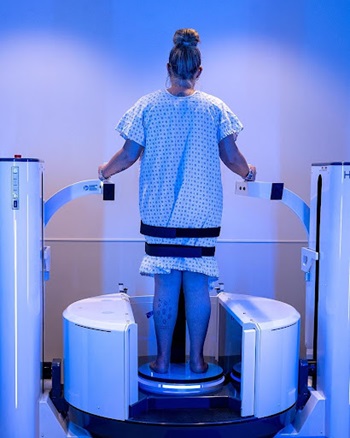
But a technology called a weight-bearing CT scan is helping to solve this issue: The scanner captures 3D images while you’re standing up.
“It provides greater insight, helps us create a precise diagnosis and allows treatment options that are unique to your structural abnormality,” says Justin Fleming, D.P.M., FACFAS, a foot and ankle surgeon at Hackensack Meridian Health’s Jersey Shore University Medical Center in Neptune.
Jersey Shore is the first hospital in New Jersey to offer weight-bearing CT scans, which reflects our commitment to innovations that improve precision and the overall treatment experience.
What Is a Weight-Bearing CT Scan?
The technology scans you while you are fully upright and supporting your own weight. At Jersey Shore, doctors use it to assess deformity, arthritis and rotational problems in the lower extremities. According to Dr. Fleming, about 60 percent of patients with ankle arthritis have some kind of deformity that the system can quickly identify.
How Does It Work?
After a consultation with a specialist for foot, ankle or knee pain, your doctor will typically order an X-ray first.
“If you meet the criteria for surgery, then a weight-bearing CT scan would likely be ordered,” says Dr. Fleming. About 1 in 5 people he sees for these issues ultimately requires surgery.
At the start of the scan, you step up onto a low platform. There are rails on either side in case you need to steady yourself. Once the technologist positions the limb being scanned, a large circular ring rotates around you, capturing images from multiple angles.
A weight-bearing CT scan typically takes five to eight minutes, according to Dr. Fleming. That’s comparable to a traditional CT scan. But the advantage isn’t speed — it’s the system’s ability to capture images in your body’s normal weight-bearing position.
What Are the Benefits of a Weight-Bearing CT Scan?
Improved Surgery Results
“When performing an ankle replacement, we’re trying to get the ankle directly beneath the knee,” says Dr. Fleming. “Your knee might appear normal if you’re lying down, but then you stand, and any misalignment becomes evident. These are important details that would be missed on a non-weight-bearing CT scan, and that alignment is critical for the long-term outcome of the surgery.”
The weight-bearing position also reveals rotational deformities, which can be hard to spot on a standard scan. (Imagine looking down at your big toe and finding it pointing at 2 o’clock instead of 12 — that’s the kind of issue a weight-bearing CT scan can catch, notes Dr. Fleming.)
Longer-Lasting Implants
“Precise and accurate ankle implant placement increases the chance of implant survival,” says Dr. Fleming. “A weight-bearing CT scan gives us the best chance for that.”
Lower Radiation Exposure
Research shows that weight-bearing CT imaging “has the benefit of reduced radiation dose” compared to a standard CT scan. The manufacturer notes that a less-than-two-minute scan of one joint involves less than 26 seconds of X-ray exposure.
A More Comfortable Experience
Stepping onto a low platform is easier on your body than lying flat on a hard surface, especially if you have lower back pain or limited mobility, says Dr. Fleming. It’s also less intimidating than the traditional CT tunnel.
Who Is a Good Candidate for a Weight-Bearing CT Scan?
It may be right for you if:
- Your doctor has recommended an ankle replacement.
- You have post-traumatic foot or ankle arthritis (the kind caused by a past injury).
- You have bones that healed incorrectly or failed to fully mend after a fracture.
- You’re being evaluated for revision surgery on a previous repair.
The Bottom Line
If you’re experiencing foot, ankle or knee pain, ask your doctor if a weight-bearing CT scan could help identify the problem.
Next Steps & Resources
- Meet our source: Justin Fleming, D.P.M.
- Make an appointment online with a podiatrist or orthopedic foot and ankle surgeon near you, or call 800-822-8905.
- Learn more about our orthopedic services.
Find a doctor near me

Understanding Poor Circulation: What Your Body’s Trying to Tell You
Learn what poor circulation means, the signs your body gives and when to see a vascular surgeon for help before it leads to serious complications.

How to Heal a Sprained Ankle
Heal your sprained ankle. Dr. Bloomstein offers advice on treatment and recovery. Learn home care tips and when to seek medical help. Call 800-822-8905.

Back on Her Feet After Ankle Surgery
Ankle surgery recovery story. Bloomfield patient Kori Potenzone shares her experience with Dr. Keller at Hackensack University Medical Center. Learn more.

Mahwah, NJ Man Gets Back in the Saddle After Ankle Surgery
Mahwah, NJ man shares his experience with the minimally invasive ankle surgery at Hackensack Meridian Health that helped him stay active.