

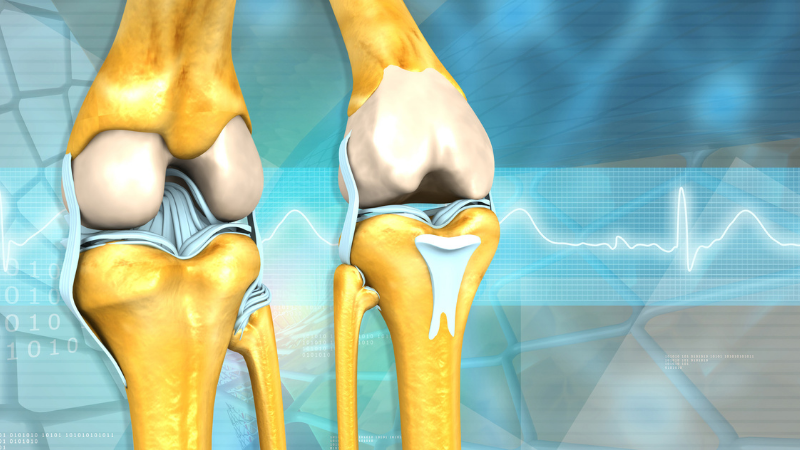
Knee pain can make simple activities like walking, climbing stairs or playing with your kids feel impossible. If you have a cartilage injury, it likely won’t heal on its own and may worsen over time.
Traditional treatments have relied on creating scar tissue to fill the gap or on implanting artificial materials. But an innovative procedure at Hackensack Meridian Health is providing a game-changing alternative.
Called matrix-induced autologous chondrocyte implantation (MACI), the treatment repairs cartilage damage with cells from your own knee, helping you get moving again more quickly and comfortably. Your doctor takes a sample of healthy cartilage from your knee, grows it in a lab and then places it back in your knee to repair the damaged tissue.
“You can use yourself to essentially heal yourself,” says Mitchell J. Stroh, D.O., FAAOS, an orthopedic surgeon at JFK University Medical Center in Edison. “It’s great to be able to offer a treatment that allows patients to get back to the activities of daily living and sports using their own tissue.”
Here’s how MACI works and how to know if you’re a good candidate for it.
What Is MACI?
MACI is a cartilage-restoration treatment used to repair injured areas of your knee.
“Cartilage is the surface of your bones,” explains Dr. Stroh.
Damage to cartilage can come from sports injuries, falls, other accidents or a dislocated kneecap. Because cartilage has no blood supply, it has limited ability to heal on its own.
MACI restores the damaged area with your own cartilage cells.
“I liken it to a road that has a pothole on it,” says Dr. Stroh. Rather than repaving the whole road, MACI fills the pothole using your own material.
What Does the MACI Procedure Involve?
The MACI procedure is done in two stages.
Stage 1
Your surgeon performs a minimally invasive procedure using a tiny camera to look inside your knee and remove a sample of healthy cartilage roughly the size of a Tic Tac®, says Dr. Stroh.
The sample goes to a lab, where cartilage-producing cells are isolated and grown on a collagen membrane over two to three weeks.
“The cells are tested rigorously to make sure everything is viable,” says Dr. Stroh.
Stage 2
Your surgeon trims the cartilage membrane to match the size and shape of your cartilage defect, implants it and secures it with a specialized adhesive.
The membrane serves as a scaffold for new cartilage growth and is gradually broken down and replaced by your own tissue over time.
Depending on where the damage is, this may be done as either an open procedure or a minimally invasive one. You usually go home the same day and then follow a recovery plan that includes physical therapy.
What Are the Benefits of MACI?
Because MACI uses your body’s cells, the new cartilage closely mimics your natural tissue, which means there’s no risk of rejection. That can typically mean faster healing and fewer complications compared to traditional cartilage repair.
Most people can return to normal daily activities within about three months. Full recovery — including a return to high-level or contact sports — usually takes about 10 to 12 months.
Another benefit: MACI is long-lasting. A review of studies found significant improvements in patients a decade after their MACI procedures. And if a future procedure like a knee replacement is ever needed, it would not require the step of first removing any artificial implants.
Who Is a Good Candidate for MACI?
MACI is approved by the U.S. Food and Drug Administration for patients ages 18 to 55 who have knee cartilage defects, though eligibility also depends on the size and location of the damage and on overall knee health. It works best for someone with a single, localized area of cartilage damage rather than widespread arthritis.
It may be a good fit if you have ongoing knee pain and want to avoid a more-invasive surgery, and it’s especially valuable for younger patients who are not candidates for knee replacement.
Next Steps & Resources
Meet our source: Mitchell J. Stroh, D.O.
• Make an appointment online with an orthopedic specialist near you, or call 800-822-8905.
• Learn more about our orthopedic care services.
Find a doctor near me

Signs You Need to Slow Down Your Exercise
Avoid exercise injuries. Dr. Ashmyan shares signs of overtraining & how to prevent them. Learn to listen to your body and prevent orthopedic issues. Call 800-822-8905.

ACL Tear and Walking: What You Need to Know for a Safe Recovery
An anterior cruciate ligament (ACL) tear is a common knee injury that can affect athletes. Discover the symptoms, treatments, and options for recovery. Whether you choose surgery or physical therapy, walking may be limited during the healing process.
Hip and Knee Replacement Keep Cruise-Lover on Board
Mike Hemhauser’s hip pain interfered with his retirement plans, from vacations to pickleball. Here’s how a hip replacement and knee replacement helped this Middletown, NJ man.
3 Advances in Joint Replacement Surgery
From AI-guided hip replacement surgery to robotic knee replacement surgery, learn about three technologies changing how doctors treat joint pain.