

Key Takeaways:
A runny nose alone doesn’t warrant a sick day:
- Stay-home symptoms: Your child should stay home if they have a high fever, vomiting or diarrhea, persistent cough, severe sore throat, certain rashes or pink eye.
- Emergency symptoms: Head to the ER if your child has trouble breathing, uncontrollable fever, signs of dehydration, lethargy or a stiff neck with fever.
- Get care: Worried about your child’s symptoms? Schedule a pediatrician appointment: Book online | 800-822-8905
Medically reviewed by Lindsey Peragallo-Flynn, D.O., a pediatrician at Hackensack Meridian Health in Forked River
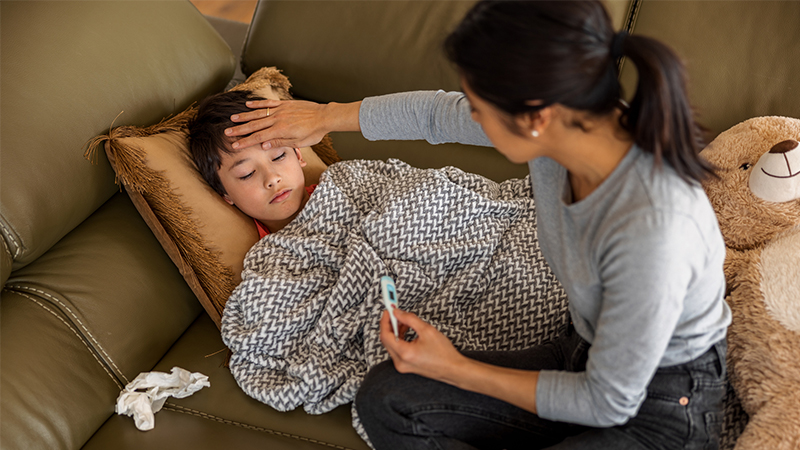
It’s 7 a.m., and your kid has droopy eyes and a runny nose. Can you still send them to school? Knowing when to keep your child home isn’t always obvious.
Sometimes it’s clear-cut: A high fever or vomiting means a sick day, says Lindsey Peragallo-Flynn, D.O., a pediatrician at Hackensack Meridian Health in Forked River.
Other times, it’s a judgment call. Take our quiz to see what your kid’s symptoms may mean.
How Often Do Kids Get Sick in School?
Kids get sick a lot, says Dr. Peragallo-Flynn. She notes that it’s normal for a school-aged child to catch something about six to eight times a year, and around 10 to 15 times a year for younger kids (i.e., babies and toddlers) or those just starting school.
“They’re exposed to bacteria and viruses all day — it’s normal for their immune systems to react,” says Dr. Peragallo-Flynn.
However, if your child is getting recurrent bacterial infections (think pneumonia, ear infections or sinus infections), that is more concerning and worth talking to their doctor about.
When to Keep Your Child Home From School
Do you really need to keep your child home from school every time they get the sniffles? Not necessarily. But these symptoms might mean a sick day:
- Fever. Keep your kid home if they have a temperature of 100.4 F or higher (or just under that number if other symptoms are also present). Kids should be fever-free for 24 hours (without fever-reducing medication) before returning to school.
- Vomiting or diarrhea. Both can be caused by conditions that are contagious, so it’s best to keep your child home until they are symptom-free for at least 24 hours.
- Persistent cough. “If your child is going to be coughing and not able to concentrate, then there’s no point in sending them to school,” says Dr. Peragallo-Flynn. A lingering cough is fine once they’re recovered and it’s controllable with honey or cough syrup (not a nebulizer).
- Sore throat. A mild one isn’t usually concerning. But if it’s severe, comes with a fever or is making swallowing difficult or painful, keep your child home and get a strep test.
- Certain rashes. An itchy, painful or spreading rash can signal a contagious infection, so keep your kid home.
- Pink eye. A red or swollen eye is very contagious, says Dr. Peragallo-Flynn; your kid should definitely stay home.
- Acting “not like themselves.” Extra tiredness, no appetite or a rough morning could be the beginning of something. Trust your gut and keep your child home if you think they’re starting to get sick.
When to Seek Care Right Away
Some symptoms need more than a sick day. Head to the ER for:
- Trouble breathing. Mild trouble warrants a same-day visit to your child’s doctor, but fast breathing, straining to breathe, nasal flaring or trouble talking means the ER, says Dr. Peragallo-Flynn.
- Uncontrollable fever. A high fever (103 F or higher) that won’t drop with medicine plus a child who isn’t acting normally require a trip to the ER. Babies under 3 months with a fever over 100.4 F should be taken to the ER.
- Signs of dehydration. If your child can’t keep fluids down, hasn’t urinated in more than eight hours, is crying but doesn’t produce tears, or is extremely tired and not drinking, seek emergency care.
- Lethargy. A child who can’t get out of bed or off the couch, or who can’t be roused to eat or drink needs the ER.
- Stiff neck with a fever. This could signal meningitis, a medical emergency, says Dr. Peragallo-Flynn. Head to the ER right away.
- Certain rashes. Tiny red or purple dots that don’t fade when pressed (called purpura) can be caused by infections like meningitis and autoimmune conditions. If your child has this type of rash, they should be seen in the ER right away.
- Meet our source: Lindsey Peragallo-Flynn, D.O.
- Learn more about pediatric care at Hackensack Meridian Health.
Next Steps & Resources
Find a doctor near me

What Do I Do When My Baby Gets a Fever?
Baby fever? Dr. Niketakis Wujciak offers guidance on care and when to seek medical attention. Learn more and schedule an appointment.

How Long Are You Contagious with a Stomach Bug?
Stomach bug contagious period? Learn how long you're contagious, prevent spread, and when to seek care from Dr. Sebti. Call 800-822-8905.

Do You Have a Cold, COVID-19, Flu, Pneumonia, RSV or Something Else? Take the Quiz
Not sure if it’s a cold, flu, COVID-19, pneumonia or something else? Take our quick winter illness quiz to compare symptoms and learn when to get tested or seek care.

Are Itchy Eyes a Sign of COVID-19?
Itchy eyes and COVID-19? Dr. Rosenberg explains if this is a common symptom and offers prevention tips. Learn more and schedule an appointment.