

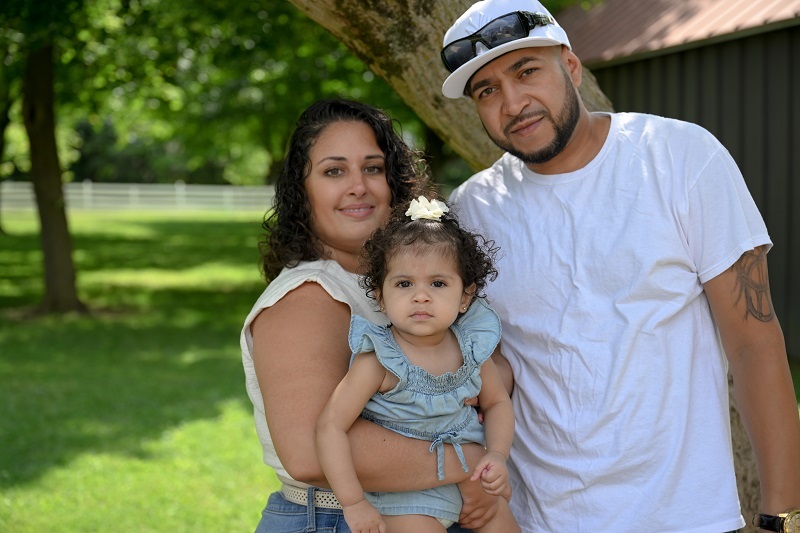
At just 9 months old, Stella Lopez, of Somerset, New Jersey, became part of a special history: Hackensack Meridian Children’s Health pediatricians taking care of three generations of women in the same family—and ensuring the potential for many more.
When Stella was about 8 months old, her parents noticed a swollen area in her groin. She didn’t cry out or make any facial expressions when her parents touched the area, says Stella’s mother, Nicole. She could press down on it just like she could with Stella’s umbilical cord hernia.
Stella, like her two older siblings, was born with an umbilical cord hernia, also called a belly button hernia. Umbilical cord hernias are fairly common and typically go away on their own.
However, an inguinal hernia, or groin hernia, does not resolve on its own. Over time, this condition can lead to life-threatening complications: If the contents of the hernia become trapped in the abdominal wall, the hernia can cut off the blood flow and become life-threatening.
A Family Affair
Stella’s parents took their daughter to their family pediatrician, Victor Tuma, M.D., who is no stranger to Nicole. He was her pediatrician when she was a child. “I’ve been in Metuchen for 51 years,” Dr. Tuma says. “I’m part of this community.”
When Dr. Tuma confirmed that Stella had a groin hernia and needed surgery, Nicole felt certain that she could trust whoever he referred her to. Stella’s parents took their baby daughter to see Mark Kayton, M.D., a pediatric surgeon and division chief of pediatric surgery at K. Hovnanian Children’s Hospital at Jersey Shore University Medical Center.
When Stella and her parents met Dr. Kayton for the first time, Nicole was so worried about her daughter needing surgery, she was crying. “It did seem like it was very common, but at the same time, this is your child, so you’re very scared,” she says.
Dr. Kayton reassured Stella’s parents and thoroughly explained the procedure. “He was very understanding of where I was coming from,” Nicole says.
Successful Surgery—Today and Beyond
Soon after seeing the family, Dr. Kayton performed laparoscopic surgery on 9-month-old Stella.
He began by inserting a tiny camera through Stella’s belly button to see the inguinal hernia. In baby girls with groin hernias, it is common for reproductive organs to become entangled in the hernia, which is a serious complication that can affect fertility, Dr. Kayton says.
As he suspected, Stella’s groin hernia was entangled with one of her reproductive organs – her left fallopian tube. Dr. Kayton disentangled the healthy tube and closed up both the groin hernia and the umbilical hernia.
Stella came through her surgery like a champ, her mother says, and the procedure was a success. By saving Stella’s fallopian tube, Dr. Kayton had contributed to her future ability to have children.
“The two specialists—all at once—had contributed to the health of three generations of this family,” Dr. Kayton says. “That made us proud.”
Next Steps & Resources:
- Meet our sources: Mark Kayton, M.D., and Victor Tuma, M.D.
- To make an appointment with a pediatrician near you, call 800-822-8905 or visit our website.
Ways to Help When a Child is in the Hospital
Support a hospitalized child? Learn how to help families cope with the emotional and logistical challenges. Find practical tips and resources.

8-year-old New Jersey Girl Finds Hope for Rare Disease

6-year-old on Road to Recovery After Bone Marrow Transplant
After Piper Law was diagnosed with a life-threatening disease in which the bone marrow doesn’t make enough blood cells, but doctors give new hope.

Doctors Remove Ovarian Cyst in Girl Experiencing Unusual Symptoms
15-year-old Emma Topp’s doctors were concerned her high blood pressure was the result of a heart problem. Imaging revealed a football-sized ovarian cyst.