

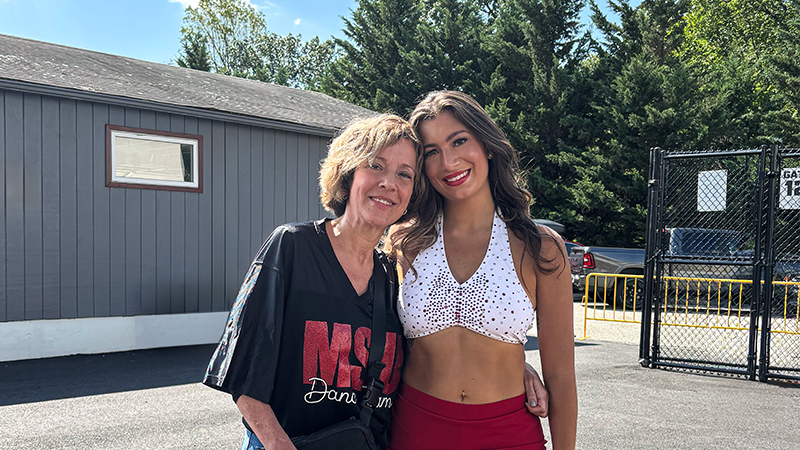
When Erika Sharples woke up in the neuro ICU at Hackensack Meridian Jersey Shore University Medical Center after experiencing a hemorrhagic stroke, she had no idea where she was or what had happened to her.
“I was unable to do much of anything,” says Erika, who was 51 at the time and living in Manahawkin. “I couldn’t follow commands, speak or eat; I was receiving IV nutrition. The team wasn’t sure if I was ever going to be able to speak again, let alone swallow solid food.”
Her stroke was caused by the rupture of an arteriovenous malformation (AVM), a dangerous tangle of abnormal blood vessels in the brain. At Jersey Shore University Medical Center - which is one of three Hackensack Meridian Health specialized stroke care centers - an endovascular surgeon performed a rapid endovascular embolization, using a tiny catheter to stop the leak of blood in Erika’s brain and remove the AVM.
It saved her life and reduced her risk of permanent neurological disability, but the road to recovery was going to be long.
“The surgeon said I had dysphagia, or difficulty swallowing, as a result of my stroke and I was going to need a lot of rehabilitation and therapy to return to my normal functioning,” Erika says.
The Effects of Dysphagia After Stroke
Dysphagia can be common after a stroke, says Henry Park, M.D., medical director of Neuro ICU at Jersey Shore University Medical Center. “Data suggests up to 80 percent of stroke survivors suffer severe dysphagia,” he notes.
Dysphagia occurs because brain damage can disrupt the muscles and nerves that control swallowing. The condition can lead to coughing and choking, as well as increased risk of pneumonia, malnutrition and dehydration.
Difficulty swallowing can also significantly impact patients’ quality of life - it can cause anxiety or panic during mealtimes, and many patients report feeling lonely or depressed when they can’t participate in social meals with family and friends. More than a third of patients who suffer from dysphagia say they avoid eating with others.
At Jersey Shore University Medical Center, Erika worked hard to get back to her pre-stroke quality of life. She did rehabilitation exercises, and her speech pathologist suggested she try a new treatment: pharyngeal electrical stimulation called Phagenyx®.
“The team thought it would be very helpful to rehabilitate my throat so I could speak and swallow again,” Erika says. Without it, she would be more likely to need a feeding tube.
How Phagenyx Helps Stroke Patients With Dysphagia
Pharyngeal electrical stimulation works by inserting a special catheter with built-in electrodes through the patient’s nose. It provides small electrical pulses to stimulate critical sensory nerves within the throat, or pharynx.
“This can reestablish communication between those nerves and the brain,” says Shabbar Danish, M.D., chair of Neurosurgery at Hackensack Meridian Neuroscience Institute at Jersey Shore University Medical Center. “The treatment lasts 10 minutes a day for at least three days and up to six days. It’s carried out by speech pathologists based on their assessment, and it’s another important tool they use to help patients regain swallowing function.”
Erika’s Phagenyx treatments started before she’d even been discharged to a rehabilitation facility for occupational and physical therapy. “After several rounds of the stimulation treatment, I was actually swallowing thickened liquids and ice cream, and then I graduated to pureed food,” she says.
The Phagenyx system has become widely adopted in Europe and the U.K. But Jersey Shore University Medical Center is the first hospital in New Jersey to routinely provide it for patients with dysphagia.
Erika’s Journey to Recovery
After her stroke, Erika spent several weeks in the hospital before moving to a rehabilitation facility. She underwent several rounds of Phagenyx treatments and was back to eating whole foods within the first 10 days of her stay at the rehabilitation facility. Her experience has given her a new appreciation for the little things in life - like her favorite foods.
“After going through something as traumatic as a stroke, I can’t say enough how great it was the first day that my daughter brought me pizza for dinner,” she says. “Imagine if I couldn’t eat pizza!”
Next Steps & Resources
- Meet our sources: Henry Park, M.D., and Shabbar Danish, M.D.
- Make an appointment online with a speech therapist near you, or call 800-822-8905
- Learn more about stroke care at Hackensack Meridian Health

How to Support Your Loved One Recovering from a Stroke
If a loved one or family member has had a stroke, you are both probably full of different questions and emotions including sadness, fear and apprehension about the future. Learn more.

Four Brain-Building Activities to Boost Attention and Focus After a Stroke
Learn simple at-home strategies to help improve mental focus after a stroke.
How to Identify Early Signs of Stroke
Recognize stroke symptoms? Learn early stroke signs from Dr. Pavuluri. Get timely medical attention to reduce disability risk.

10 Ways to Lower Your Risk of Stroke
Lower your stroke risk. Learn 10 ways to improve your heart health and reduce stroke risk from leading doctors. Find resources and next steps.