

New Risk Assessment Aims To Stop Cancer Before It Starts
When it comes to cancer prevention, screenings are crucial — they can help detect cancer early, when it’s most treatable.
Now, a new cancer risk assessment offered by the Hennessy Institute for Cancer Prevention & Applied Molecular Medicine is making it even easier to catch cancer before it starts. The program aims to identify cancer risk long before a tumor ever forms—and catch existing cancers at their most curable stages.
The Hennessy Institute is one of just a handful of centers in the country conducting cancer screening at scale and shifting cancer diagnoses to earlier stages.
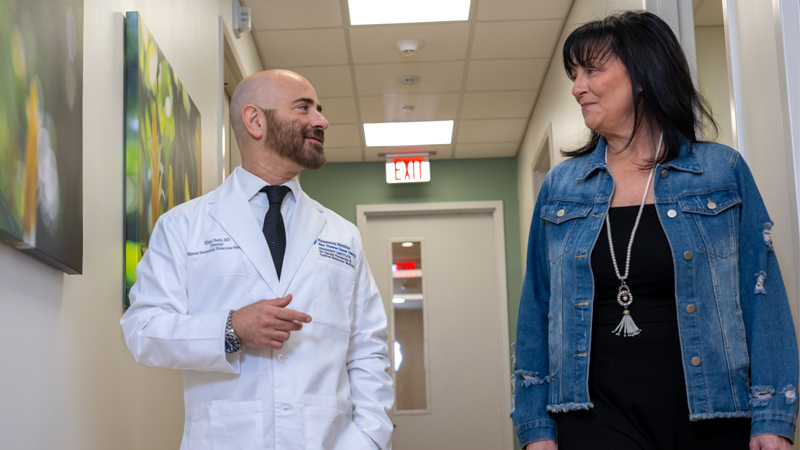
“The Hennessy Institute is here to help anyone who is interested in knowing about their cancer risk in general and what they can do about it,” says Elias Obeid, M.D., MPH, medical director of the Hennessy Institute.
Assessing Your Cancer Risk
The first step is to complete the cancer risk assessment, which takes less than five minutes. It includes questions about your family history, cancer history and health background, such as smoking history.
“It’s a few minutes that could save your life,” Dr. Obeid says.
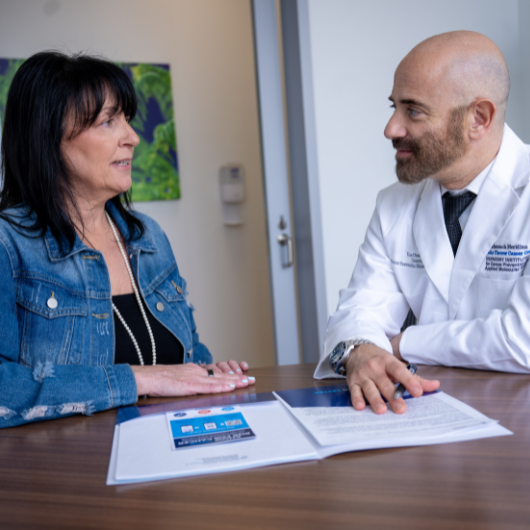
After completing the questionnaire, you get a detailed report about your cancer risk. Afterward, a nurse will call you to discuss the next steps based on your results, such as genetic testing. The genetic tests are easy-to-use at-home options that include a saliva or oral cheek swab test that checks for cancer-causing gene mutations.
The genetic test can be mailed to your home — it doesn’t require a visit to a lab or a doctor’s office. You simply spit into a tube or swab your cheek, then mail the sample for testing. Labs analyze your saliva to check for gene mutations.
Insurance usually covers the genetic test for eligible individuals; if yours doesn’t, the Hennessy Institute can provide resources to help offset the cost of testing.
Once the team has your results, they will call you to discuss further care with a cancer expert, if necessary. Depending on the follow-up care needed, you might be seen again within the Hennessy Institute or referred to partner care providers in the area, Dr. Obeid says.
Taking Charge of Your Health
Sometimes, the results of the genetic test lead to more than just additional cancer screenings.
Kathleen “Kathi” Auriemma, the lead PTO/benefits system support in human resources for Hackensack Meridian Health, took the assessment and underwent genetic testing in April 2025.
The 55-year-old, who lives in Hasbrouck Heights, was nervous about her results since she was diagnosed with melanoma in 2019 and has had several family members with cancer.
Her genetic test revealed that she carries a mutation in the PMS2 gene and has Lynch syndrome, which increases a person’s risk for several types of cancer, including colorectal, endometrial and ovarian cancer.
These results allowed Kathi and her doctors to take preventive action quickly.
In August 2025, she had a colonoscopy and a mammogram. Then, she underwent a risk-reducing hysterectomy (removal of the uterus) and bilateral salpingo-oophorectomy (removal of the ovaries and fallopian tubes) to prevent endometrial and ovarian cancer.
“With Lynch syndrome in particular, there is a very high risk for colon cancer, uterine cancer and other cancers,” Dr. Obeid says. “A finding like this is lifesaving for Kathi.”
She also adopted a yearly colonoscopy schedule for people at high risk for colorectal cancer. During a subsequent procedure, doctors were able to identify and remove precancerous polyps, effectively preventing cancer before it could develop.
Today, Kathi is glad she went through with her risk-reducing procedures, and recommends genetic testing to anyone who is curious to learn more about their own cancer risk.
“It’s easy: You take a little questionnaire, and you spit in this thing, and you send it back, and that’s it,” she says.
Life Saving Results
Mark Needleman, a semi-retired optometrist in Westfield, New Jersey, was concerned about his family’s history of cancer. His brother had pancreatic cancer, his aunt had uterine cancer, and there was non-Hodgkin’s lymphoma and liver cancer in his family, too.
He completed the risk assessment in March 2025. The results suggested he’d be a good candidate for genetic testing, so he was sent a saliva test. He found it simple to complete and appreciated that it was covered by his insurance.
His results showed he carries a mutation in the BRCA2 gene, which is associated with an increased risk of breast cancer, prostate cancer and pancreatic cancer in men. It’s also associated with an increased risk of melanoma.
As a result, he was advised to get a mammogram to screen for male breast cancer, an endoscopic ultrasound to screen for pancreatic cancer and a prostate-specific antigen (PSA) test to screen for prostate cancer. He was also advised to see a dermatologist annually to check for melanoma.
“I have to be watched,” Mark says.
Alongside his care team, he’s weighing how often to repeat these screening tests so he can get ahead of a cancer diagnosis.
Learning about your cancer risk can be scary, Dr. Obeid acknowledges.
Sometimes it’s enough to scare people away from seeking more information, which is part of why his goal at the Hennessy Institute is to make the process as simple as possible.
He also reminds people that genes are not a guarantee of a diagnosis — but they’re also not going anywhere.
“You might be 50 years old, and you might be living for another 50 years with those genes,” he says. “But not knowing about a genetic risk factor doesn’t make that risk disappear.”
“Be proactive,” he urges, “because there are things that you can do about your cancer risk once you know what it is.”
Next Steps & Resources
- Meet our source(s): Elias Obeid, M.D., MPH
- Make an appointment online with a medical oncologist near you, or call 800-822-8905.
- Take the cancer risk assessment now.
- Learn more about the Hennessy Institute for Cancer Prevention & Applied Molecular Medicine.

Breast Cancer Screening: Calming the Waters
Breast Cancer Screening: Find peace of mind. Learn about mammograms, ultrasounds, and biopsies. Palisades Medical Center offers comprehensive care.

When To Get A Colon Cancer Screening
While most cases of colon cancer happen in those over 50, cases of colon cancer are rising among those under 50. Read on to know if you are at risk and should be screened.
The Facts About Lung Cancer Screening
Learn lung cancer screening facts. Early detection improves survival rates. Simple, low-risk procedure. Call 800-822-8905 to schedule.

Father and Son Overcome Colorectal Cancer Thanks to Timely Screenings
When Don Heddy turned 50 in December 2019, he knew there was one thing he needed to do: schedule a colonoscopy. Like anyone trying to stay on top of their health, he was faithful to that. But he didn’t expect the outcome.