

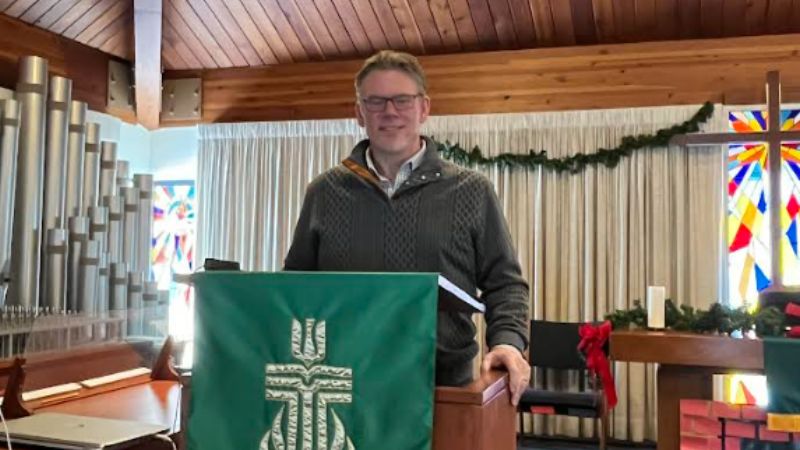
55-year-old Todd Shumpert, a Pastor at United Presbyterian Church in Cedar Grove, considered himself fairly healthy. However, a routine test told a different story for the father of two
After recently changing his primary care physician, Todd was encouraged to get a cardiac calcium CT scan, a suggestion prompted by his Type 2 diabetes. The non-invasive imaging test finds and measures plaque in the arteries. It provides a score ranging from 0 to 400 to indicate heart disease risk.
Todd’s score was in the 600s, a dangerously high number indicating extensive plaque buildup and a severe risk of a heart attack. His primary care physician referred him to a cardiologist, who performed several tests, which also returned abnormal results. Finally, a cardiac catheterization revealed a critical blockage in the left anterior descending (LAD) artery, an artery so vital it's notoriously known as the "widowmaker."
“I was shocked. I had no symptoms and didn’t realize I was walking around with a life-threatening heart condition,” he says.
A Robotic Surgical Solution
Todd knew that he would need surgery, but was hoping he could have a minimally invasive approach that would allow him to recover faster. Unfortunately, doctors discovered a birth anomaly that made stenting, a common, less invasive procedure, less than ideal. Todd was told traditional open-heart surgery would be his best option.
It was an idea he found devastating. “I asked the doctors if there was any other way. The idea of the procedure and recovery was just too much,” he says.
His cardiologist, Mark Anderson, M.D., at Hackensack University Medical Center, had a solution. Dr. Anderson is a pioneer in a new heart procedure, robotic cardiac surgery.
Dr. Anderson explained that instead of a large incision, Todd’s surgery would be minimally invasive. Using small incisions on the side of his chest, robotic arms controlled by the surgeon would perform the delicate procedure.
“Robotic cardiac surgery is a transformative alternative that allows us to perform complex procedures, like the intricate bypass Todd required, through a few small incisions instead of opening the chest,” explained Dr. Anderson. “This minimally invasive approach is far less intrusive, leading to significantly less pain, a lower risk of complications and a much faster recovery.”
Back at the Pulpit
The surgery took place in Hackensack University Medical Center’s new Helena Theurer Pavilion. Because surgeons entered through his side, one of Todd’s lungs had to be temporarily deflated, making post-procedure breathing more difficult. But with tools and support from the cardiac team, Todd did well.
The following Sunday, just one week later, Todd was back home in Bloomfield. He says his recovery was nothing short of remarkable. He missed only one Sunday service. The week he returned, he led worship from a rocking chair, much to the amazement of his congregation.
“Our goal is to get people back to their lives, their families and their passions as quickly as possible. Seeing a patient like Todd return to his congregation just one week after a major heart operation is a powerful testament to the benefits of this technology and the incredible resilience of the human spirit," says Dr. Anderson.
Today, Todd says he feels great and is grateful to his primary care doctor and Dr. Anderson's team.
“Without the amazing care that I received from Dr. Anderson and the entire team at Hackensack Meridian Health, I wouldn’t be here today,” he says.
He also has a new testimony to share. In addition to telling everyone about his experience, he also placed a message in his church bulletin, urging others to get the simple scan that saved his life.
“Today, I feel fantastic. I tell anyone I can about the importance of prioritizing your health and listening to your doctors. We are all busy, but we can make time for our health,” says Todd.
Next Steps & Resources
- Meet our expert: Mark Anderson, M.D.
- Make an appointment online with a cardiologist near you, or call 800-822-8905.
- Schedule a cardiac calcium scan.
3 Ways to Get Screened for Heart Disease
Discover 3 heart disease screenings. AngioScreen, CT Calcium Scoring, and HeartFlow help detect issues early. Schedule your screening today.

Uncommon Warning Signs of Heart Disease
Learn uncommon heart disease warning signs from leading cardiologists. Recognize shortness of breath, dizziness, and more. Improve your heart health today. Call 800-822-8905.
Father of Four With Advanced Heart Failure Given New Hope
Michael Riley had months to live as a result of his advanced heart failure. Doctors at Jersey Shore University Medical Center found a way to reverse that heart failure.
Emergency Heart Care Rescues Busy Professional
Advanced heart treatment saves Eva Maravelias after a devastating cardiac event.