

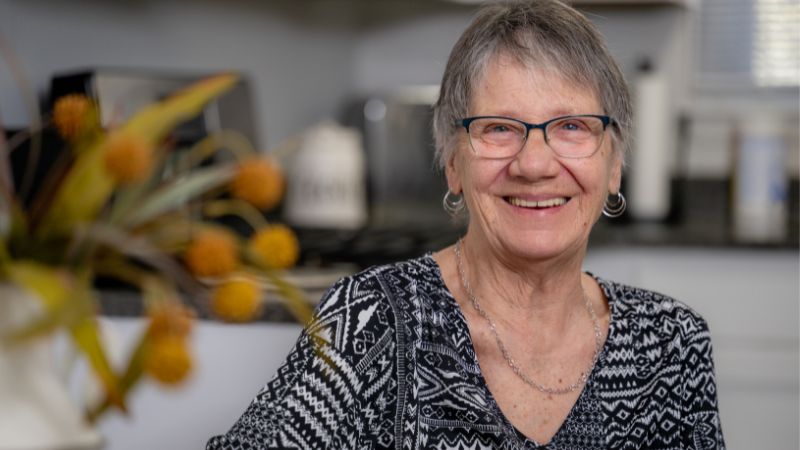
When 74-year-old Cecelia Lucas ended up in the emergency department at Southern Ocean Medical Center for severe stomach pain over Memorial Day weekend 2022, she had a sense of déjà vu. She had been in the same place for similar complaints two years earlier, almost to the day.
Fortunately, her stomach pain was due to a blockage that was easily resolved. However, Arthur DeMarsico, D.O., a vascular surgeon and chair of surgery at Southern Ocean Medical Center, found a bigger issue: a descending thoracic and an abdominal aortic aneurysm.
“When Dr. DeMarsico came into my room and told me about the aneurysms, I almost jumped out of bed. I had no idea that I had it, and I knew what it was because my brother had to have a very involved surgery for the same thing,” she says.
Descending thoracic and abdominal aneurysms (DTAA) are dangerous, often silent, widenings of the main artery (aorta) that can occur at the same time. If these aneurysms get too big or rupture, they can be life-threatening. They can be hereditary, but are also associated with high blood pressure and other heart issues. Dr. DeMarsico explained to Cecelia that she would only need surgery if her aneurysm reached a certain size, and for the time being, they would just monitor it.
From Vigilant Monitoring to Necessary Surgery
Cecelia began seeing Dr. DeMarsico for routine imaging studies every six months. Over the course of two years, the aneurysm grew from 4.6 cm to 5.6 cm. At that point, Dr. DeMarsico told Cecelia she needed surgery. It was an idea that terrified Cecelia.
“The surgery my brother had for the same thing was rough, and he had a long and difficult recovery. It’s not something that I wanted to go through,” she says.
During traditional open surgery for descending thoracic and abdominal aneurysms, surgeons make a long incision in the chest to access the diseased section of the aorta and replace it with a synthetic graft. The surgery is often considered high-risk and carries long recovery times.
Dr. DeMarsico knew Cecelia was nervous about the surgery and offered an alternative, Thoracoabdominal Branch Endoprosthesis (TAMBE), a new minimally invasive surgery designed to treat complex aortic aneurysms. During the procedure, a stent graft is inserted through small incisions in the groin. The surgery also utilizes a device with four branches to maintain blood flow to the kidneys, liver and stomach.
“Cecelia was a good candidate for this surgery. The procedure was designed to treat aneurysms like hers, and because it is minimally invasive, it results in less blood loss, shorter hospital stays and a faster recovery,” says Dr. DeMarsico.
Collaborative Approach
Because Cecelia’s case was more complex and involved a lot of moving parts, Dr. Demarsico thought it would be a good opportunity to collaborate with some of his colleagues, including Satishkiran Kedika, M.D., vascular surgeon at Jersey Shore University Medical Center.
“I’ve worked with Dr. Kedika on a few other cases, and I thought this would be a chance to come together and move a novel procedure forward. One of the benefits of being a patient at Hackensack Meridian Health is that you have access to physicians who will collaborate to bring you the most innovative options possible,” he said.
Ultimately, Dr. DeMarsico and Dr. Kedika chose to perform two minimally invasive procedures to repair Cecelia’s DTAA. They suggested spacing the procedures to minimize stress on Cecelia’s body. The first procedure, Thoracic Endovascular Aortic Repair (TEVAR), was a more common catheter-based approach that could be done at Southern Ocean Medical Center. The TAMBE procedure would be done at Jersey Shore University Medical Center.
While there are many advantages to TAMBE, both physicians warned Cecelia about the risks. As a newer procedure, it has not been done as often. However, Cecelia was quick to choose the minimally invasive procedures.
“I trusted Dr. DeMarsico and Dr. Kedika completely. They were upfront with me from the start about what was involved, and I was willing to accept any risk to avoid the traditional procedure,” says Cecelia.
Recovering in Half the Time
Cecelia had her TEVAR procedure done in July, 2025. She only stayed one night in the hospital and recovered well. Dr. DeMarsico and Dr. Kedika performed the TAMBE procedure a few months later, on September 5. Although Cecelia was admitted to the Intensive Care Unit as a precaution, she never suffered any complications.
“She did great following her surgery. She recovered well and was up and moving around soon after surgery,” Dr. Kedika says.
Today, Cecelia is back to her normal activities and says she is grateful to the doctors who worked together to develop a solution that met her needs.
“I was basically living with a ticking time bomb in my chest. I thought I was facing a dangerous and morbid surgery and recovery. I’m so glad that Dr. DeMarsico worked with Dr. Kedika and was aware of the minimally invasive solutions being offered. I’m forever thankful for both of them,” she says.
Next Steps & Resources
- Meet our sources: Satishkiran Kedika, M.D., and Arthur DeMarsico, D.O.
- Make an appointment online with a vascular surgeon near you, or call 800-822-8905.
- Learn more about vascular surgery at Hackensack Meridian Children’s Health

Understanding Poor Circulation: What Your Body’s Trying to Tell You
Learn what poor circulation means, the signs your body gives and when to see a vascular surgeon for help before it leads to serious complications.

What Do Blood Clots in the Leg Feel Like?
Leg blood clot symptoms? Learn about pain, swelling, and redness from Drs. Jain and Armstrong. Get care now to avoid complications. Call 800-822-8905.

Three Worst Drinks for Your Brain Health, According to Neurologists
You may know that certain foods can affect your brain health, but did you know that what you drink also has an impact? See which beverages are the worst.

What’s Causing My Headache and Is It Serious?
Find relief from headaches. This guide explores causes, prevention tips and how to identify warning signs of more serious medical issues.