

Key Takeaways
A stroke cuts off blood flow to the brain and requires immediate emergency treatment.
- Diagnosis: Joanne Dunn started experiencing stroke symptoms following lung surgery from a bacterial infection.
- Treatment: Surgeons at Jersey Shore performed an emergency thrombectomy to remove a blood clot from her brain.
- Get Care: Learn the signs of stroke. Schedule a neurology appointment: Book online | 800-822-8905
Medically reviewed by Laura Risley, M.D. Vascular Neurologist, Hackensack Meridian Jersey Shore University Medical Center
Sudden Symptoms After Surgery
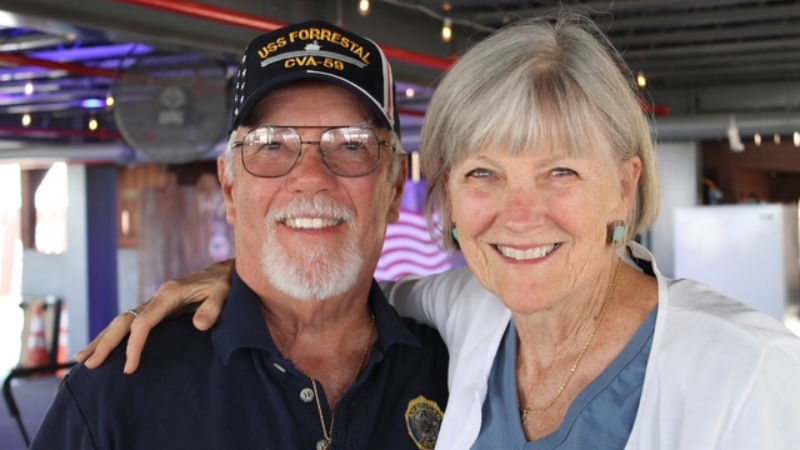
Joanne Dunn, a 73-year-old retired hospice social worker from Middletown, New Jersey, is alive today because of perfect timing.
In June, 2024, Joanne was recovering at Hackensack Meridian Riverview Medical Center. She had just undergone surgery to remove a third of her left lung due to a severe bacterial infection. As she ate lunch in her hospital room, Joanne picked up a cup of coffee and suddenly spilled it all down her front.
Her husband of 47 years, Roger, sat right beside her and knew instantly that something was wrong.
“One minute she was fine,” Roger said. “The next minute I saw she was drooling a little bit and fumbling with her utensil. She was trying to speak but she was mumbling. She got a droop in her chin and her mouth, and I jumped up and ran out to tell the nurse, ‘Something’s wrong, you’ve got to come in.’”
Rushing to Emergency Stroke Care
A rapid response team arrived immediately. Joanne was rushed to Jersey Shore University Medical Centerfor complex stroke intervention.
“Stroke can be traumatic because it’s so sudden,” said Laura Risley, M.D., a vascular neurologist at Hackensack Meridian Neuroscience Institute at Jersey Shore, who was part of Joanne's care team.
“In an instant—one second you’re fine and the next second you’re not. It’s a lot to process for our patients and families.”
Removing the Blood Clot
a neurosurgeon immediately performed an emergency thrombectomy. During this highly specialized procedure, a surgeon removes a blood clot from the brain. This intervention restores blood flow and oxygen, which prevents brain cell death and minimizes permanent damage.
“Once she got to Jersey Shore, it was amazing how fast they took care of her,” Roger said.
Following the successful procedure, the neurosurgeon met Roger in the waiting room and showed him a picture of the nearly inch-long blood clot he had just removed.
“He saved her life,” Roger said. “Thank God we got her down there as fast as we did.”
Walking Out Two Days Later
Because Riverview and Jersey Shore operate as a unified network, rapid transport and advanced treatments happened in a matter of minutes. This swift action gave Joanne the best possible outcome.
“Almost all of Joanne’s deficits were resolved after intervention,” Dr. Risley said. “It is unfortunately rare to be able to walk out soon. We approach every stroke patient with the hope that we can give everyone results like Joanne, but time is the enemy with stroke. The intervention window is only hours and too many patients don’t get to us fast enough. It is estimated that 2 million brain cells are lost every minute during a stroke; so every second makes a difference.”
If Joanne had not received immediate treatment, the outcome would have been drastically different.
“The natural progression of the stroke, if left untreated, would have been left-sided paralysis, visual loss on her left side, facial droop, difficulty with swallowing and possible feeding tube, and living in a nursing home with 24-hour care,” Dr. Risley explained.
Instead, Joanne was discharged just two days after suffering a life-threatening stroke.
“I walked out of Jersey Shore on June 16th on my own two feet, holding my husband’s hand on our wedding anniversary,” Joanne said.
While they couldn’t go out to dinner that night, Roger whipped up Joanne’s favorite dish: chicken parmesan. Every day while she regained her strength, he made her meals and encouraged her to take five laps around their backyard.
“He walked the laps with me, holding my hand,” Joanne said.
Focusing on the Future
Today, Joanne continues to manage minimal left-sided weakness. She regained her strength with the help of outpatient physical and occupational therapy. She also follows up regularly with Dr. Risley to monitor her progress and manage risk factors like blood pressure, cholesterol and blood sugar.
“Stroke care from a medical point of view is definitely a team sport,” Dr. Risley noted. “Having medical, family and social support improves recovery.”
Joanne now spends her time painting in watercolors, working as a background actor for local television shows and enjoying her four grandchildren and one great-grandchild.
“I like to say I have the A-Team at Jersey Shore taking good care of me,” she said. “I am so grateful for my medical team. They are just top-notch, and I wouldn’t consider going anywhere else. They’re not just skilled clinically; they’re such compassionate, empathetic people. I never leave anyone's office there without getting a hug.”
Reflecting on her survival, Joanne lives by a new motto.
“I will not let my fears of tomorrow rob me of my joys of today,” she said. “Every morning I get up and I say, ‘Thank you, God, for another day.’ Those are the cards I was dealt, and they’re pretty damn good cards.”
Next Steps & Resources
- Meet our source: Laura Risley, M.D.
- Learn more about stroke care at Hackensack Meridian Health.

Stroke Symptoms in Women: Signs You Shouldn’t Ignore
Women are more likely to have a stroke than men, and the signs can look different. Learn the stroke symptoms in women you need to know.

Stroke Recovery: Debbie Naroff Scott is Helping Others by Sharing her Stroke Journey
When Debbie Naroff suffered a subarachnoid hemorrhage in December 2020, she felt isolated and lonely. She credits Hackenack Meridian Health Intensive Care Nurse Christine Kim for helping her through one of the scariest times of her life. Now she’s sharing her story to help others.

AngioScreen Findings Prevent Heart Attack and Stroke
Geralyn’s AngioScreen uncovered an unexpected blockage in her carotid artery and alerted her to potential other problems.

How to Help Prevent Stroke
Prevent stroke: Reduce your risk with expert tips from Dr. Uhrik. Learn how lifestyle changes can improve heart health. Call 800-822-8905.